Why & How Leaders in the Region Build Meaningful Public Presence

In our third capability development-centred conversation, we explored a question that continues to surface in executive rooms across the GCC: Why does public visibility feel uncomfortable for leaders in this region, and why has it become increasingly consequential?
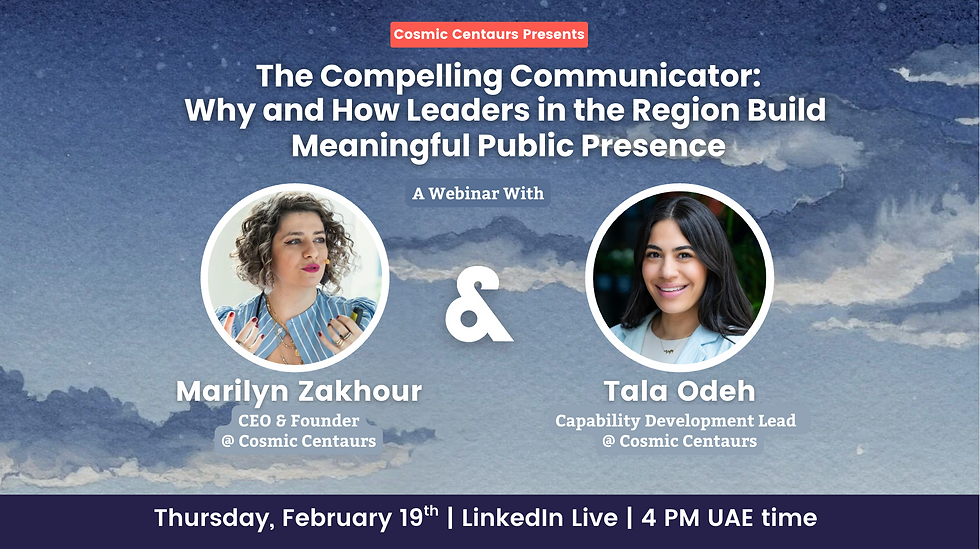
In this session, Tala Odeh, Head of Capability Development at Cosmic Centaurs, flipped the mic on Cosmic Centaurs CEO & Founder Marilyn Zakhour. What unfolded was a discussion about culture, responsibility, economic transformation, and the discipline required to translate leadership depth into public voice.
The conversation moved through four chapters: the leadership visibility gap in the GCC, the strategic opportunity created by public voice, the structural foundations required to build credibility, and the deeper promise of disciplined leadership expression.
Watch the webinar below, or listen to it as a podcast here
Why do Leaders in the Region find it so challenging to build a public presence?
The discomfort around public speaking and thought leadership in the region is often misread as hesitation or insecurity. While public speaking is among the highest-ranked fears in theworkplace (HBR). In reality, this fear is rooted in communication norms.
Arab cultures are high-context. Meaning is layered. Dignity, subtlety, and relational awareness shape expression. Complexity is not instinctively compressed into repeatable headlines. When stepping into global platforms that reward clarity through reduction, this creates friction.
As Marilyn reflected during the conversation:
“We are not a culture that instinctively compresses complexity into soundbites. We value nuance. We think in layers. When we enter global discourse, the friction is not because we lack depth. It is because we have not been trained to translate that depth into formats that travel. We do not need to abandon nuance. We need to translate it.”
This distinction is critical. The solution is not simplification of thought. It is disciplined structuring of it.
Humility and Visibility Are Not Opposites
The more emotional tension, however, lies elsewhere. Many leaders in the GCC were raised with the belief that their work should speak for itself. Modesty was not only a personal virtue but a cultural expectation. Collective achievement mattered more than individual spotlight. There is integrity in that posture.
But in an environment where narratives are shaped daily across global media, LinkedIn, conferences, and investor forums, silence does not remain neutral.
Marilyn articulated the polarity clearly:
“In cultures that prize modesty and collective success, visibility can feel uncomfortable. I used to believe that my work should speak for itself. But at the level of leadership, visibility is not ego. It is responsibility. If you are shaping sectors, influencing thousands of employees, directing capital, your silence has consequences. It creates interpretive space. And someone else will tell your story for you.”
This is the inflection point. Visibility shifts from self-promotion to narrative stewardship.
The Structural Lag
Historically, leaders in the region did not need to cultivate public presence in the Western sense. Influence was built in majlis and diwans. Trust was relational. The media did not cultivate CEOs as public intellectuals. Speaker circuits were limited. Structured executive communication development was not systemic.
Then the region accelerated: Vision 2030. The UAE 2031. Kuwait Vision 2035. Sovereign capital reshaping global markets. Infrastructure and technology agendas unfolding at an extraordinary pace. The market evolved faster than leadership preparation did.Marilyn framed the asymmetry bluntly:
“Our economic ambition is globally visible. Our leadership voices are not. That is the gap. When global media covers transformation in the region, who are they quoting? If our leaders are not shaping that narrative, consultants and analysts from outside the region are doing it for them, often without lived context.”
The data support this imbalance. Over a seventeen-year period, fewer than two management journal articles per year, per journal, focused on the Arab world (source) and many of those lacked Arab authorship entirely. Meanwhile, the region’s economic contribution continues to expand at scale.

Cosmic Centaurs explored this gap on stage at the 2025 Misk Global Forum, where we co-created a workshop with more than 80 Saudi youth to examine what is distinctive about Saudi leadership and what the rest of the world could learn from it. The insights from those discussions were later published in our report, Leadership Made in Saudi.
This initiative forms part of Cosmic Centaurs’ broader commitment to ensuring that the MENA region’s intellectual leadership footprint does not remain under-articulated in global discourse.
Leadership Storytelling as Cultural Continuity
At this point, the conversation shifted through Tala’s lens. She reframed visibility not as a Western import, but as cultural continuation.
The region has always been rooted in storytelling. The hakawati. The majlis. The diwan. Leaders transmitting history, values, and judgment across generations through narrative. Modern platforms are simply contemporary extensions of that lineage.
Where once stories were shared around a fire, they are now shared across digital platforms and global stages. The medium has evolved. The responsibility to articulate meaning has not. Seen this way, public leadership voice is not a departure from humility. It is a continuation of heritage at scale.
The Strategic Opportunity
If visibility feels culturally complex, its strategic value is commercially clear.
Marilyn was unequivocal that leadership voice is not a vanity exercise.
“A leadership voice is a strategic asset. Visibility accelerates trust, and trust shortens everything. It shortens sales cycles. It shortens partnership negotiations. It shortens investor conversations. When someone has already encountered your thinking and understands what you stand for, you do not begin from zero in the room. You begin from credibility.”
Executives estimate that a CEO’s reputation accounts for 45% of company market value. Corporate reputation represents a significant share of total market capitalization across global indices.
Employer brand is equally affected. A CEO’s good reputation attracts 77% of new employees and retains 70% of current ones. In a young, digital-first workforce, invisibility creates distance. Thought leadership directly influences commercial receptivity with 90% of decision-makers reporting greater openness to outreach from organizations that consistently produce high-quality thought leadership. Sixty percent are willing to pay a premium for those who do.
Narrative Ownership
Every leader has a narrative. The question is whether they are the author or merely the subject. Marilyn expressed this plainly:
“If you are not actively shaping how your leadership, your company, and your industry are understood, someone else is. And they may not have your context, your values, or your long-term interests in mind.”
In a region under intense global scrutiny, narrative ownership becomes strategic. It becomes a form of sovereignty.
The How: Building a Compelling Presence
The Compelling Communicator programme emerged from repeated encounters with exceptional leaders who remained silent.
“They had the substance. They had the credibility. What they did not have was a structured process for translating all of that into a visible, consistent leadership voice.”
The programme begins with purpose. Leaders clarify what they stand for beyond quarterly metrics and what tension in their industry they feel responsible to address. Without purpose, visibility becomes noise.
It then moves to audience-centricity. Visibility is reframed as service. The guiding question becomes what the audience needs to hear and what tension they are carrying, not what the leader wishes to announce.
Next comes structure. High-context thinkers identify content pillars and develop narrative assets. Leaders articulate three to five pivotal career moments that anchor their leadership philosophy and can travel across formats. Confidence, Marilyn argued, is rarely the root issue.
“Most leaders I work with are not lacking confidence. They are running major organizations. The gap is specific to public expression. The solution is not simply to push through fear. It is to clarify your message, practise it in safe environments, and let clarity carry you.”
Rapid Fire:
Which leadership quality matters most in building public presence?
“Discipline. This takes work. I sit every week and think about what I stand for and what my audience needs. Keynotes take hours. Writing takes time. Visibility is not spontaneous. It is a disciplined commitment.”
What is the biggest mistake leaders make when building a public presence?
Overvaluing depth at the expense of consistency.
What is one thing you wish you knew before beginning this journey?
“No one cares that I exist.” Not as dismissal, but as freedom. The imagined scrutiny that holds leaders back is far larger than the reality.
If you have earned a seat of influence and know your voice should carry further than it currently does, this is the moment to build the discipline behind it.
The Compelling Communicator is a structured, one-to-one journey designed for leaders who are done waiting for their work to speak for itself.
Register your interest today: https://forms.gle/dZaBzLEcaUR1J8WR7


Comments