Three Motivation Myths and What Actually Drives Performance

This article is part of our Make It Count series, which supports leaders in turning the last weeks of the year into a period of clarity, renewed discipline, and meaningful progress.
Motivation is usually described as something personal, yet research consistently shows that it is shaped far more by the systems surrounding people than by individual traits alone. McKinsey’s global performance survey reports that 70 percent of motivation is influenced by organizational factors such as clear goals, consistent expectations, and manager support.
At the same time, the psychology of motivation is broader than simply being driven or not. Harvard Business Review explains three major sources that influence how people approach their work:
Understanding the types of motivation
Intrinsic motivation
Energy that comes from within. People feel motivated because the work has meaning, offers satisfaction, or sparks curiosity.
Extrinsic motivation
Energy shaped by outside factors. This includes recognition, rewards, expectations from managers, or visible progress toward goals.
Internalized motivation
Energy that begins externally but becomes personally meaningful. Someone may complete a task because it aligns with their values or identity, even if it originated as an external expectation.
These distinctions show up clearly in our team’s lived experience.
Lea shared how grounding habits help her stay steady during demanding work. “When I am facing a hard or draining task, I pair it with something I love. It keeps the effort more manageable and helps me stay motivated.” Her experience reflects intrinsic motivation supported by structure.
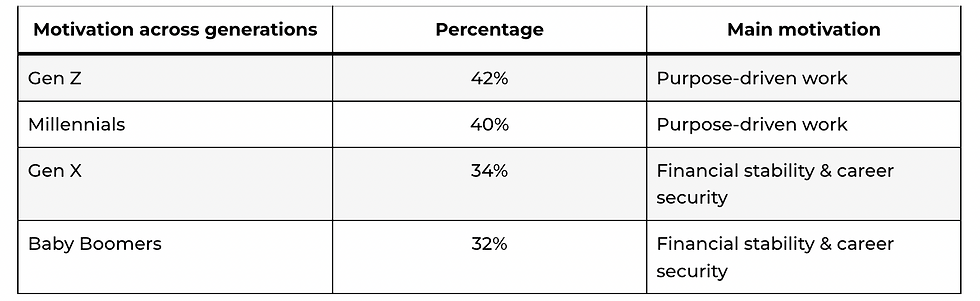
Nadine finds energy through meaning. “Pausing and returning to the bigger picture helps me focus and regain energy.” High5’s analysis reinforces that understanding purpose strongly correlates with higher motivation.
Source: Deloitte
Zeina describes how progress fuels her. “Knowing that my contributions will turn into something fruitful keeps me going. Motivation is consistency.” McKinsey’s data aligns with this by showing measurable goals strongly influence engagement.
These reflections form the foundation for understanding why common assumptions about motivation often fail in practice. The myths below outline the ideas leaders rely on most frequently, along with the more effective alternatives supported by research and experience.
Myth 1: Perks create lasting motivation
Perks, treats, and celebrations offer positive moments. They rarely create sustained motivation on their own. High5’s research highlights that clarity, recognition, and a sense of contribution have a much stronger influence on long-term engagement.
We see this in our team.
Hadeel explained how pausing to acknowledge progress lifts her energy. “My energy is renewed the moment we pause and celebrate our wins.”
Nadine finds that simple weekly rituals help her reconnect with meaning and stay grounded.
What supports motivation in this area
Recognition that is specific and connected to actual progress
Clear explanations of how individual work contributes to team goals
Rituals that help teams reflect, reset, and reconnect with purpose
Myth 2: Pushing harder will unlock motivation
Pressure can lead to a short burst of activity. Sustained motivation grows when people experience ownership, clarity, and meaningful involvement in shaping their work. McKinsey’s research indicates that employees are significantly more motivated when they take part in defining their goals and understand how those goals connect to company priorities.
Razan felt her motivation increase when she was invited to help shape direction. “What shifted everything was when my lead trusted me to help shape the direction.”
Racha regained clarity when she lifted her perspective from the task to the bigger picture. “Seeing the project from a bird’s-eye view restored clarity and kept my motivation steady.”
Lea felt supported when a manager acknowledged her workload with empathy and asked how they could help.
What supports motivation in this area
Collaborative goal-setting conversations
Clarity around outcomes so teams can propose the path
Light reflection practices such as mini retrospectives or decision reviews
Myth 3: Motivated teams can absorb any dysfunction
Motivation weakens in environments with unclear expectations, shifting priorities, or behaviors that undermine psychological safety. HBR shows that toxic dynamics consistently erode performance, regardless of individual motivation levels.
Sabah spoke about how empathy helped her learn with confidence. “Being guided with empathy through something new helped me see that growth welcomes imperfection.”
Marie described how thoughtful feedback helped her protect her energy and leadership clarity.
What supports motivation in this area
Co-created collaboration norms
Recognition that reinforces psychologically safe behaviors
Regular one-on-ones that surface pressure, blockers, and support needs
Sustaining Motivation
Motivation fluctuates. It is strengthened by purpose, progress, and stability. It is depleted by noise, unclear expectations, and unmanaged pressure.
Leaders influence motivation most through the systems and rhythms they create: clear goals, predictable routines, honest conversations, and rituals that help people stay connected to meaning. These structures protect motivation through long cycles of delivery and make performance more sustainable.
Celebrations and end-of-year gestures matter. They help teams close chapters well. The real impact comes from everything that happens between those moments.
If you want to reinforce clarity, alignment, and sustained motivation in the year ahead, our Ritual Bank offers simple formats that help teams build these foundations with intention.


Comments