Systems Thinking for Leaders: Diagnosing Invisible Dynamics and Hidden Patterns in Organizations

Phase I of our series: Why Leaders Need to be Thinking in Systems
Most organizational problems do not present themselves as system failures. They appear as missed deadlines, exhausted teams, siloed decisions, or stalled execution. Leaders respond with new meetings, structures, or incentives, yet the same issues return in different forms.
This is the signal leaders often miss: When problems persist, the root cause usually sits in the system that produces them.
Systems thinking shifts leadership from reacting to visible disruptions to diagnosing the underlying structures, feedback loops, and assumptions that shape behavior and outcomes. Without this lens, fixes often repeat the pattern they were meant to resolve. With it, leaders can recognize patterns, identify root causes, and intervene where change holds over time.
In complex organizations, effectiveness comes from understanding and redesigning the system behind recurring issues.
Most system transformation journeys move through three connected phases: diagnosing system dynamics, intervening intentionally within the system, and adjusting through feedback and learning.
This article opens a three-part series on systems thinking and explores each phase of that journey for leaders working in complex environments.
Phase I (you are here): Diagnosing Invisible Dynamics and Hidden Patterns in Organizations
Phase II: Acting Inside the System: How Leaders Shift Patterns
Phase III: Implement Feedback Loops for Adaptive Organizations
This current article focuses on Diagnosis, the stage where leaders move below the surface to sense, map, and name the forces shaping everyday outcomes. It is where patterns become visible and assumptions are tested. Without a clear diagnosis, even well-intended actions can miss the mark or reinforce the very dynamics leaders are trying to change.
When Symptoms Become Sirens: Recognizing the Signals
Before we map, we must notice. Recurrent issues like silos, burnout, or inefficient decision-making are signals of systemic dysfunction.
Silos may be the tip of an iceberg. Teams hoard information because incentives, structure, or power dynamics push them to.
Slow decisions could result from overloaded information flows, unclear accountability, or conflicting norms about risk.
Teams that always deliver ‘against all odds’ can signal a system that normalizes strain and undervalues recovery.
These symptoms act as signals, revealing deeper issues within the system. In the same way a fever signals infection, your organizational symptom signals the deeper system to be explored.
Ask: What is a recurring challenge that you see in your team or organization?
Pro tip: Gather 3–5 recurring “headache” stories from your team. Write them out in plain narrative. Use those as your entry points. Real stories help you stay grounded.
Diagnostic Tools: Exploring Icebergs, Fishbones, and Archetypes
Once you have symptoms in view, diagnosis tools help you push deeper from what you can see to what’s driving it.
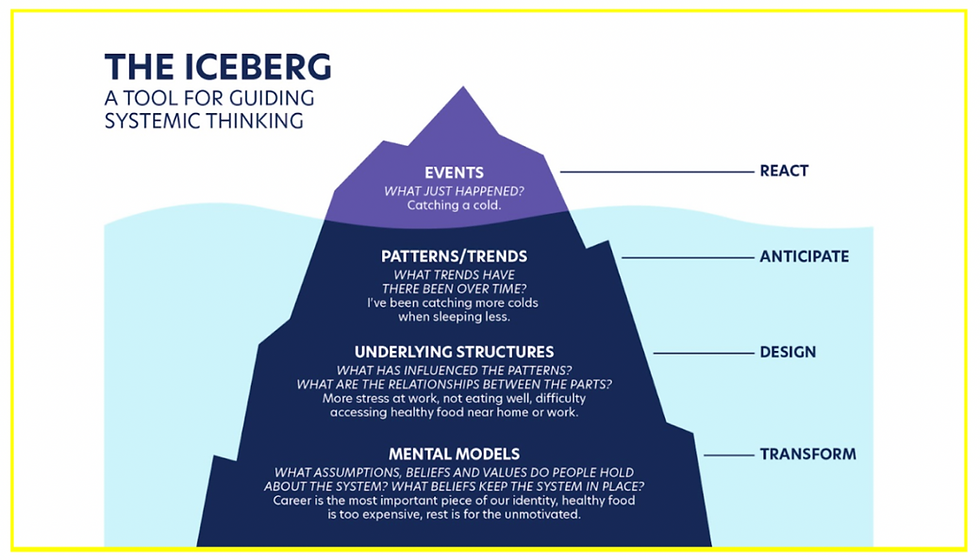
A. The Iceberg Model
The Iceberg Model helps leaders trace how Events → Patterns → Structures → Mental Models flow.
Events: Observable actions or incidents. → A team member says, “Leave this work with me, I’ll get it done,” and takes over a shared task.
Patterns: Recurring trends or behaviors over time. → The same person repeatedly steps in to finish others’ work, becoming the go-to problem solver.
Structures: Systems, processes, and norms that shape behavior. → The organization rewards individual heroics over collaboration; workloads and responsibilities are unevenly distributed.
Mental models: Deep beliefs, assumptions, and values driving the system. → The underlying belief is, “If you want something done right, do it yourself”, a mindset that values control and self-reliance over trust and collective accountability.
In diagnosis mode, you train your gaze from top (events) downward into structures and mental models. That is where the leverage often lies.
B. Fishbone (Ishikawa) Diagram
The Fishbone Diagram helps you focus on causes so you don’t investigate everything at once. Start by drawing a spine representing the problem statement, with ribs labeled for categories such as people, process, structure, technology, or norms. Place possible root causes into the relevant ribs.
This method supports you in making sense of complexity, avoiding the “everything is a cause” trap, and identifying clusters of recurring causes. Once causes are grouped, you can generate testable hypotheses, for example, “If we change X, then Y will improve”, instead of relying on guesswork.

System Archetypes
Once you see systems, you begin noticing recurring patterns called System Archetypes, which describe how cause and effect interact over time. Recognizing them helps leaders diagnose issues faster and avoid familiar traps. Once you know which one you’re in, you can pause, step back, and design interventions that rewrite the script, turning repeating patterns into deliberate progress.
Below are eight archetypes that capture recurring behaviors.

3. Bringing Diagnosis to Life: A Mini Case Study
Consider the Wells Fargo cross-selling scandal. In pursuit of growth, the bank pushed employees to sell multiple products to each customer. Over time, extreme pressure to meet sales targets led to millions of fake accounts being opened without customer consent.
Looking at this case through systems thinking helps reframe the problem and reveal what truly needs to change.
→ Using the Iceberg Model: Seeing Beneath the Surface
Seeing the whole iceberg reveals how surface problems trace back to deeper assumptions and designs:
Events: fake accounts, customer complaints, employee stress
Patterns: repeated sales spikes followed by reputational damage and turnover
Structures: incentives focused on quantity, fragmented oversight, ambitious growth goals
Mental models: “sales = success,” “growth proves leadership,” “targets matter more than trust”
→Using the Fishbone Diagram: Tracing the Roots of Pressure
When we map the problem “Pressure to Meet Sales Targets” through a Fishbone Diagram, different contributing factors begin to surface and reveal how incentives and culture intertwined to favor short-term targets over lasting customer trust.
Processes: daily quotas, minimal time with each customer
Incentives: bonuses for volume, not value
Leadership: constant performance pressure
Culture: fear of missing goals, silence around ethical concerns
→Looking through the Systems Archetype: “Success to the Successful”
The Wells Fargo case reflects a classic pattern called Success to the Successful. Employees who hit high sales numbers were rewarded and promoted, which encouraged others to chase the same results. Over time, the system kept amplifying what it measured, more accounts, more sales, while overlooking what mattered most: real customer value and trust.
4. Turning Diagnosis into Insight
The Wells Fargo case illustrates how systemic thinking shifts attention from individual actions to the structures, incentives, and beliefs shaping them. The goal isn’t to correct individuals but to design conditions where the right behaviors happen naturally. Leaders ask not, “Why is Team A underperforming?” but “How do we balance interdependence, accountability, and information flow across teams?” This shift in framing opens new possibilities for action.
Teams often create system maps to explore these relationships. Simple node-and-arrow diagrams show how factors influence one another, for example:
“Overwork → mistakes → rework → more overwork,” points out a reinforcing loop.
Mapping reveals leverage points, where small shifts, like clarifying roles or redefining metrics, can ripple into broader improvement.
Mapping Tips:
Stay curious as you map your system.
Test your assumptions continuously.
Invite others to challenge your mental models.
Let the map evolve: it doesn’t need to be perfect.
Focus on building a shared understanding of how decisions, flows, and beliefs create organizational results.
Diagnosis is the discipline of slowing down before acting. It asks leaders to pause quick fixes long enough to understand what the system is designed to produce and why. Mapping structures, incentives, and mental models turns problems from frustrating mysteries into solvable design challenges.
Without this step, action is often misdirected. With it, leaders gain clarity, alignment, and a shared language for change. Diagnosis does not provide answers on its own, it creates the conditions for better decisions, wiser interventions, and more durable outcomes.
In the next article of this series: Phase 2: Acting Inside the System: How Leaders Shift Patterns, explore how insight becomes leverage and deliberate design choices reshape organizational outcomes.
---
Understanding systems thinking is critical for leaders, as even strong strategies and capable teams can struggle inside poorly designed systems. In 2025, our sixth Cosmic Conference: “The system is the strategy” explored this idea, bringing together leaders, researchers, and practitioners to examine real organizational challenges through a systems lens. At Cosmic Centaurs, we help leaders drive meaningful change, from upskilling teams and shaping culture to guiding leaders in finding their voice; to take the next step, book a one-on-one consultation with us today.


Comments